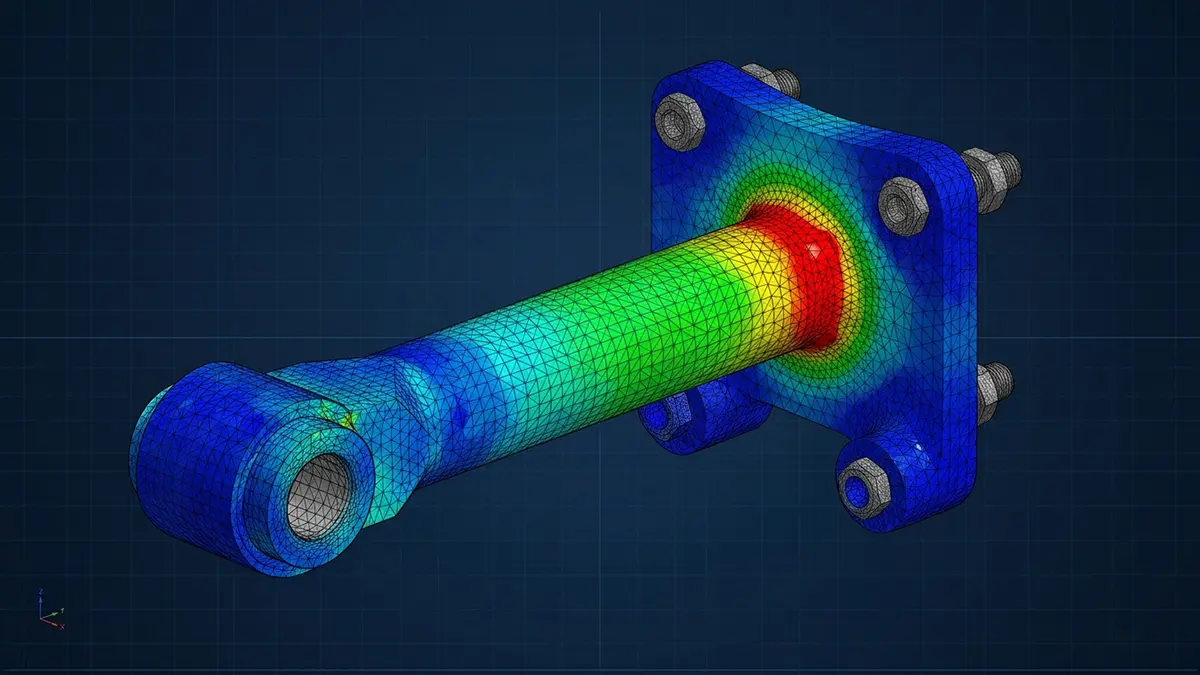

You have a new product to validate. The deadline is tight, the physical prototype is costly, and the team doesn’t want to find out that the structural strength is insufficient after the parts have been cut. Finite Element Analysis (FEA) is the tool that answers you before you get to that point.
This guide explains what FEA is, how it works, what it asks of an engineer and technical manager, and why it matters in the manufacturing industry.
What is finite element analysis
Finite element analysis is a numerical technique for approximating solutions to problems with boundary conditions. Specifically, it’s the method by which you calculate what happens to a structure, fluid or thermal system when you subject it to forces, temperatures or pressures – without building a physical prototype for each scenario.
The scope is wide: structural, thermal, fluid dynamics, acoustic or multi-domain physical problems. They all share the same mathematical principle: a differential equation describing the physical behavior that classical calculus cannot solve exactly for complex geometries.
FEA solves this limitation by a conceptually simple strategy: divide the continuous domain into small, finite elements, solve the system on each element, then assemble the results into a global solution.
How the finite element method works
The process follows six well-defined steps, regardless of the software or type of problem:
1. Domain discretization (network of elements)
The component geometry is divided into small elements – triangles and squares in 2D, tetrahedra and hexahedra in 3D. Each element has nodes at the corners and, in some formulations, also on the sides. The quality of the discretization network directly influences the accuracy of the results: a dense network in areas of stress concentration and sparser in areas with small gradient means computational efficiency without loss of accuracy.
2. Weak variational weak form
The strong differential equation – hard to solve directly – is transformed into an equivalent, more permissive form that can be approximated on every element. This is the mathematical foundation on which the whole method is built. You don’t need to master it to use FEA, but you do need to understand that it exists, otherwise you won’t know when to trust the results.
3. Shape functions and degrees of freedom
On each element, the physical field under study – displacement, temperature, pressure – is approximated with polynomial functions called shape functions. The unknown values are calculated in nodes, called degrees of freedom. A 1D bar element has 2 nodes and 2 degrees of freedom. A 3D hexahedral solid element can have 20 nodes and 60 degrees of freedom.
4. Global stiffness matrix assembly
Each element contributes its own stiffness matrix to a global system of linear algebraic equations. The assembly process connects neighboring elements through common nodes. The result is a sparse system of large dimensions – thousands or millions of unknowns in complex industrial models.
5. Applying boundary conditions and solving
The imposed displacements (constraints) and external forces are applied, then the system of equations is solved numerically. Modern solvers – direct or iterative – handle large systems efficiently, even on ordinary hardware.
6. Processing and validation of results
From the nodal displacements the derived fields are calculated: stresses, strains, heat flux, pressures. This stage is where the engineer adds real value: interpreting the results, identifying critical areas and validating the model against experimental data or simplified analytical analysis.
Types of problems solved by FEA
The finite element method is not limited to structural strength. Here are the direct fields of application:
Static structural analysis – checking stresses and deformations under constant loads. It is the most common type of analysis in the equipment industry.
Modal analysis – determination of eigenfrequencies and vibration modes. Critical for rotating equipment or structures exposed to dynamic stresses.
Thermal analysis – temperature distribution and heat flow. Used for cooling systems, engine casings, heat exchangers.
Fatigue analysis – estimating life under cyclic loads. Essential in the automotive and aeronautics industries.
Impact analysis and unsteady dynamics – simulation of fast transient events such as collisions or mechanical shocks.
Problems with coupled physical fields – interaction of several physical fields simultaneously: structural-thermal, fluid-structural, electromagnetic-thermal.
What an engineer doing FEA needs
Running an FEA solving program is not the same as doing FEA correctly. There are three separate skills and each one counts:
Understanding the physics of the problem. If you don’t know what type of effort dominates – bending, shear, fatigue – you don’t know what to look for in the results. FEA amplifies formulation errors, not hides them.
Proper modeling. The type of element chosen, the discretization grid density, boundary conditions and geometric simplifications determine whether the model is representative. A poorly constructed model gives accurate results of a scenario that does not exist in reality.
Verification and validation. Any FEA model must be verified – that it solves the equations correctly – and validated – that it reproduces real physical behavior. Without this step, the results are numbers without engineering credibility. Szabó and Babuška, in their seminal work on Finite Element Method: Formulation, Verification and Validation, devote an entire section to these concepts and explain why ignoring them has led to notable failures in industry.
When these three skills work together, FEA becomes a decision tool, not just a computational tool. This is the framework within which we work in the engineering analysis and optimization processes – from the correct problem formulation to redesign recommendations based on numerical results.
FEA software: what engineers use in industrial projects
There is no single right answer. The choice depends on the type of problem, the level of integration with the CAD flow and the budget.
ANSYS – complete commercial platform with modules for all types of analysis. Standard in the automotive, aerospace and energy industries.
Abaqus (Dassault Systèmes) – powerful in nonlinear and complex materials analysis. Preferred in domains where material behavior is critical.
NASTRAN – produced by NASA, later commercialized, used extensively in the aeronautics and defense industries.
COMSOL Multiphysics – problem-oriented with coupled physical domains, with accessible interface for multi-field interaction.
MATLAB PDE Toolbox – useful for rapid prototyping and validating conceptual understanding, also recommended by academic resources such as Larson and Bengzon’s lecture notes.
Each of these tools requires specific training and knowledge of its limitations. An experienced engineer knows that software executes – the engineering decision remains with the human.
Common mistakes in industrial FEA projects
If you saw FEA results that later did not correlate with reality, one of these was most likely the cause:
The discretization network too coarse in areas with stress concentration. The small radius of a thread or a recessed corner requires local densification. A uniform grid over the entire part is almost always insufficient.
Borderline unrealistic conditions. Perfect embedding does not exist in reality. If you model a connection as perfectly rigid when in reality it allows partial rotation, the calculated stresses are wrong.
Ignoring non-linearities. Linear analysis is fast, but does not represent the behavior of materials beyond the elastic limit or geometries that deform significantly under load.
Lack of comparison with analytical solutions. Any new FEA model should first be validated on a simple case with a known analytical solution. NAFEMS – the reference organization for standards in numerical engineering analysis – offers a course dedicated exclusively to these verification practices in industrial context.
Von Mises tension misinterpretation. It’s a useful scalar for comparison with the yield limit, but it doesn’t tell you anything about the direction of the stresses. Many engineers stop at the color map without analyzing stress tensors.
FEA as part of an integrated engineering flow
FEA does not live in isolation. It is one component of a wider engineering flow, starting with the CAD model and ending with the physical validation or production decision.
A well-constructed CAD model – with clean geometry, no degenerate surfaces or voids – significantly reduces the analysis preparation effort. When the geometry enters the analysis properly prepared, the discretization network is generated without errors and you don’t waste time in cleanup iterations.
The situation gets more complicated when working with existing industrial equipment for which there are no CAD models or complete documentation. In this case, digital reconstruction of the part is the necessary step before any simulation – without a model, you have nothing to analyze.
How FEA relates to industrial process simulation and validation
FEA at the component level is one thing. Simulating a complete process – assembly flow, machine kinematics, robotic behavior – is another.
Both are based on the same principle: you validate virtually before you build physically. The difference is in the scale and type of model. If you want to understand how industrial process-level simulation reduces commissioning costs, the article on the cost-effectiveness of robotic simulation and offline programming completes the picture well.
What you should take away from this guide
The finite element method is a powerful tool, but not one that works without training. Some key ideas:
The discretization network, boundary conditions and model validation matter more than the software of choice. A competent FEA engineer gets useful results even with modest tools. An engineer without understanding of the method can produce wrong results with the most expensive software on the market.
If you are a technical manager or project manager, what you should ask for is not “an FEA analysis”, but a verification and validation report that explains what has been modeled, what has been simplified, what has been validated and where the limitations of the model are. This is the difference between an analysis that supports a decision and one that creates an illusion of certainty.
If you’re an engineer just starting out in FEA, Open University offers a free introductory course with hands-on exercises on plate and beam elements – a solid starting point without excessive theory in the first few hours.
Are you working on a project that requires structural or performance analysis?
The Centerline Romania team performs complete engineering analysis – from CAD model preparation to interpretation of results and design optimization recommendations.
Contact us to discuss your project requirements, or explore our engineering analysis and optimization services directly to see what types of problems we work with.