
Every extra kilogram of an industrial product costs money over its lifetime. More material consumed. Higher energy consumption in operation. Higher logistics costs. Limited performance compared to the competition.
Structural optimization turns this equation on its head. It uses mathematics and finite element analysis to reduce the mass of a product without compromising strength, stiffness or service life. Results documented in the literature show mass reductions between 10% and 30% for automotive components, and studies on aerospace composite structures demonstrate even more significant savings when material and geometry are optimized together.
This article introduces you to the seven methods that dominate current industrial practice. You will understand when to use each method, what constraints the manufacturing process imposes, and how the results translate into competitive advantage for your business.
Why weight reduction matters in industry
Mass reduction is not an academic exercise. It is a direct financial lever.
In the automotive industry, every kilogram saved per vehicle reduces fuel consumption and CO₂ emissions. In aerospace, the ratio is even more severe: one kilogram saved per aircraft means thousands of liters of fuel saved over its lifecycle. In industrial manufacturing, lighter structures allow smaller engines, cheaper transportation and installation with standard equipment.
There is another, less obvious gain. Optimized components consume less raw material. That means lower purchase cost, but also a sustainability advantage that is increasingly important in European supply chains.
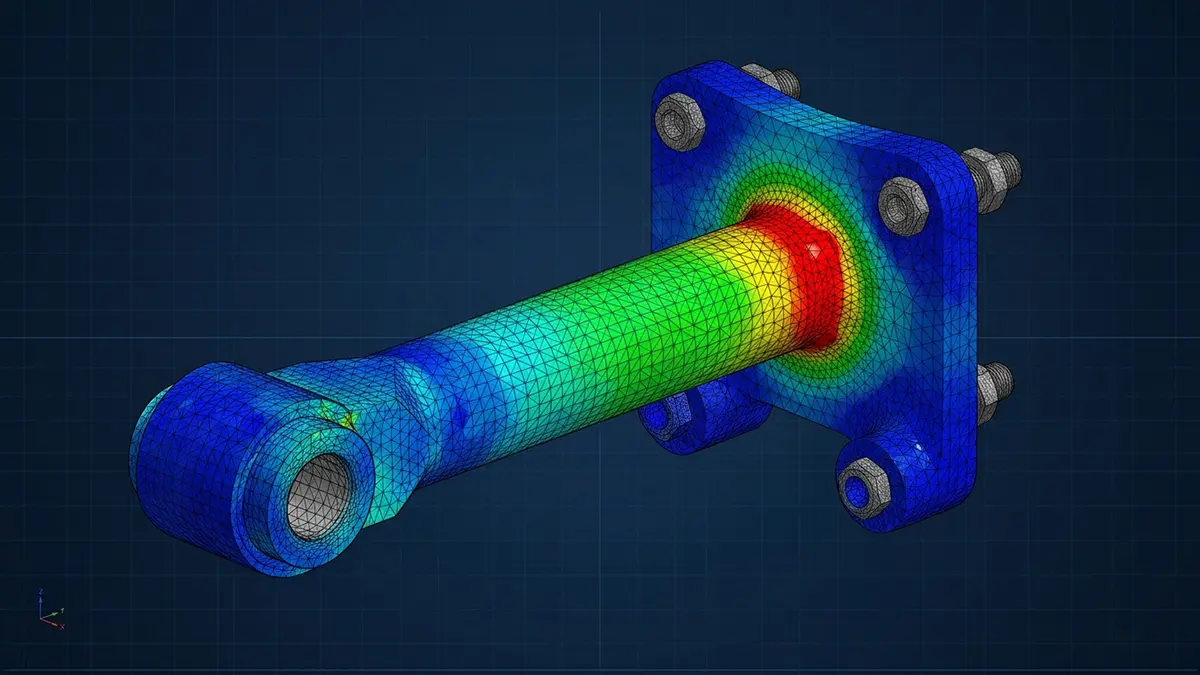
Common to all the methods you will see below is finite element analysis (FEA). Structural optimization without FEA is impossible in modern industrial practice. Algorithms run iterative simulations and adjust design variables until the mass reaches the mathematical minimum compatible with the constraints imposed by loads, eigenfrequencies and safety factors.
Method 1: topological optimization
Topological optimization starts from a design volume and determines where there should be material and where not. The algorithm mathematically redistributes the mass, eliminates low stress areas, and consolidates critical load paths.
How it works
The most widespread approach is the SIMP (Solid Isotropic Material with Penalization) method. Each finite element is given a continuous density between 0 and 1. The stiffness is penalized so that the solution converges to clear results: solid or hollow material. This results in organic geometries, similar to bone structures, which cannot be obtained by conventional design.
An alternative method is level-set, which evolves the structure boundaries by implicit functions. It produces smoother contours, easily transferred to CAD for further refinement.
When you use it
Topology optimization is the right choice when you have maximum geometry freedom and large design volume. Structural supports, handling arms, chassis frames, engine mounts. All are classic candidates. For a car frame optimized by an adapted NSGA-III algorithm, a study published in the Proceedings of the IMechE reports a mass reduction of 17.6%, while respecting the constraints of stress, displacement and eigenfrequency.
Things to keep in mind
The resulting geometries are often impossible to manufacture by traditional methods. Without manufacturing restrictions explicitly imposed in the solver, you get parts that require additive manufacturing or molding in complex molds. The manufacturing cost can wipe out the mass gain.
Method 2: Lattice structures for additive manufacturing
Lattice structures (repetitive cellular networks) replace the massive material with an internal skeleton that retains rigidity at a fraction of the original mass.
Types of latexes useful in industry
There are three main families used in industrial practice:
- Gyroid lattices – three-dimensional networks without self-intersections, excellent for heat transfer and energy absorption
- Honeycomb – high compressive strength, used in sandwich panels
- Bar Lattices – Node-connected bar networks, most versatile for local optimization
The combination of topological optimization and filling with lattice structures is the standard method in modern aerospace applications. The filled volumes determined by the algorithm are then populated with cellular structures designed to meet the local stresses.
Practical restrictions
Lattices require additive metal or plastic manufacturing in over 95% of cases. This economically limits the application to high value parts, small series and industries where cost per kilogram is critical. Aerospace. Medical equipment. High performance sports components.
Method 3: generative design
Generative design is the next step after classical topological optimization. Artificial intelligence algorithms simultaneously explore thousands of geometry variants for a given set of constraints. The engineer no longer proposes a single solution, but chooses from a space of automatically generated solutions.
Difference from topological optimization
Traditional topological optimization solves a single problem: minimum mass for given constraints. Generative design solves multi-objective problems: it simultaneously optimizes mass, cost, manufacturing complexity and assembly constraints. The result is a Pareto set, i.e. geometries that represent the best possible trade-offs between the conflicting objectives.
For a technical manager, that means informed decisions. You see five choices on the screen: one optimized for table, one for cost, one for classic CNC manufacturing, one for molding, one for additive manufacturing. You choose the one that’s right for your project.
Practical implementation
Platforms such as Autodesk Fusion 360, nTopology and Siemens NX integrate generative design modules that use neural networks and evolutionary algorithms. For a solid technical introduction, Autodesk’s document on generative design explains the multi-objective workflow and constraints in detail.
The hidden cost: calculation time. A single run can take hours or days. The investment is justified for serial or strategic impact parts.
Method 4: Integration of composite materials
A material lighter than steel, with equivalent stiffness, changes the rules of the game. Polymer matrix composites reinforced with carbon or glass fiber offer strength-to-weight ratios unattainable with traditional metals.
Stratification optimization
In composites, optimization is no longer just about geometry. You have to decide:
- Layer order
- Fiber orientation in each layer
- Local laminate thickness
- Additional reinforcement areas
Evolutionary algorithms, in particular genetic algorithms, are the standard tool for stratification optimization. The search space is combinatorial and non-convex, so gradient-based methods do not perform satisfactorily.
Baseline study
A published study on optimizing an aircraft wing with reinforced composite panels uses MSC Nastran/Patran for static and modal analysis. The result demonstrates mass reduction by optimizing the layering while meeting strength and buckling stability criteria.
Watch out for real costs
Composites bring mass gains but add complexity to assembly. Metal-composite joints require special solutions (structural adhesives, threaded inserts). Repairs are more difficult. Recycling is still an area of active research. The decision has to take into account the whole life cycle of the product, not just the mass.
Method 5: selective reinforcement
Not every area of a piece needs to be thick. Selective reinforcement identifies critical points and adds material only there, leaving the rest of the structure light.
Typical applications
- Stiffening ribs in castings
- Local reinforcements in welded structures (at joints or around holes)
- Metal inserts in plastic parts
- Composite reinforcement plates on existing steel structures
The logic of the approach
You start from a minimum base geometry. Then you run FEA simulations to identify areas of overstress. You add material only there, in the form of ribs or local reinforcement. The result is a part with less mass than a uniformly thick variant, which should have met the most stringent requirements everywhere.
For castings, this method is combined with shape optimization at the detail level. The joining radii, rib orientation and transitions between sections are refined to reduce stress concentrators. The result is a part with optimized mass and longer service life. If your projects involve welded structures or structures with repetitive load cycles, fatigue analysis is the critical step that validates selective reinforcement.
Method 6: Multi-level optimization
Multi-level optimization looks at the component on two scales simultaneously: macro (global shape) and micro (local microstructure). This approach is the current standard for additively manufactured parts made of architectured materials.
How it works
At the macro level, the algorithm determines the density distribution according to topological optimization principles. At the micro level, each intermediate density region is populated with a cell structure designed to produce the required mechanical properties. The result is a part that behaves as a graded material with properties that vary point by point as needed.
Competitive advantage
For high-performance applications, this approach produces parts that would otherwise be impossible. Imagine a component with rigid zones for force transmission and flexible zones for vibration absorption, all in a single part printed from a single material.
Practical requirements
The required software (nTopology, Altair OptiStruct with lattice module, Ansys Discovery) and metal additive manufacturing equipment raise the entry threshold. The investment is justified for organizations producing high value parts in medium to low volume. Target industries: aerospace, medical devices, motorsport.
Method 7: optimizing shape
Shape optimization adjusts the position of the boundaries of an existing part without changing the topology. No new holes are created. No additional structural elements are created. Only existing contours are mathematically refined.
When you use it
After topology optimization, the results are rough. The geometry is almost pixelized, hard to transfer directly to CAD for manufacturing. Shape optimization is the finishing step. I smooth the contours. Refine the radii. Reduce voltage concentrators.
Measurable benefits
For parts subject to fatigue, shape optimization can double or triple component life without significant changes in mass. Optimum coupling radii, section transitions and stress decay angles are the elements that make the difference between a part failing at 100,000 cycles and one that lasts over 1,000,000.
Manufacturing compatibility
Unlike topological optimization, shape optimization produces geometries directly compatible with traditional manufacturing. CNC milling, turning, metal die casting. The combination of shape optimization and traditional manufacturing provides the right cost-performance balance for most mass-produced industrial components.
Comparison and applicability
Each method has its strengths. The mental table you need to construct as a decision-maker sounds like this:
- Topological optimization: maximum mass reduction but complicated manufacturing
- Lattices plus additive manufacturing: spectacular parts for high unit values
- Generative design: speed of solution exploration and multi-objective decisions
- Composites: quantum jump in mass to strength ratio, high process cost
- Selective reinforcement: gradual improvement while maintaining existing manufacturing flow
- Multi-level optimization: technological peak, justified only by demanding applications
- Shape optimization: life-extending refinement without major investments
In real projects, these methods are combined. You start with topological optimization for concept. Continue with shape optimization for refinement. Validate with detailed FEA analysis (static, modal, fatigue). Adapt the result to your manufacturing capabilities.
Trade-offs not to ignore
Mass reduction always comes with a hidden cost. The short list of real trade-offs:
Manufacturing cost. Optimized geometries are often more expensive to produce. Additive metal fabrication costs 5 to 50 times more per kilogram than conventional casting or forging. An honest economic calculation quantifies the gain in operation against the cost of production.
Validation and certification. For regulated industries (aerospace, medical, safety-critical automotive), an algorithmically optimized part requires an extensive validation file. Detailed FEA reports, physical testing, possibly and reliability-based optimization that integrates material and load variability.
Extended design cycle. Optimization algorithms consume computing time. The iterations are fewer than in a classical process, but each takes longer. Plan realistically in the project schedule.
Tolerances and assembly. Optimized parts often have geometries with tighter tolerances in critical areas. Assembly with other standard components may require special fixtures and dimensional inspection procedures.
Where to start
Structural optimization is not an isolated project. It is a strategic competency that you build over time. The first step is an initial analysis of your product portfolio: which components have a major impact on your total lifetime cost, what are the current performance hurdles, what manufacturing capabilities do you have available.
The second stage involves a pilot project. You choose a high-potential component, not the most complex in your portfolio. Apply one or two of the methods described above. Validate the results under real operating conditions. Capitalize lessons learned for future projects.
For projects that involve converting existing equipment, reverse engineering provides a digital starting point on which you then run the optimization. If you are starting from scratch, your CAD modeling strategy directly influences how easily you will integrate the optimization results into your production model.
Let’s put theory into practice
Reducing mass on an industrial component requires the right combination of FEA expertise, optimization software and manufacturing experience. The Centerline team integrates these skills for projects in automotive, industrial equipment and energy.
Want to identify where you have the biggest mass gains in your current portfolio? Discuss our engineering analysis and optimization services concretely or contact us directly on the contact page for an initial assessment.
Frequently asked questions about structural optimization
What is the difference between topological optimization and generative design?
Topological optimization solves a single mathematical problem: the minimum mass for the imposed constraints. Generative design simultaneously explores multiple objectives (mass, cost, manufacturing complexity) and produces a set of Pareto solutions from which you choose according to your design priorities.
How much can the weight of a component be reduced through structural optimization?
Typical savings reported in the literature are between 10% and 30% for automotive chassis and frame components. For combined optimized aerospace parts (topology, lattice and composite), savings can exceed 40%. The actual percentage depends on the initial geometry, manufacturing constraints and load level.
Can I use topology optimization results directly for CNC manufacturing?
Not directly. Geometries resulting from topology optimization have rough contours that require refinement through shape optimization and CAD interpretation. For classical CNC manufacturing significant adjustments are required. For additive manufacturing, geometries can be used with minimal modifications.
What software is used for industrial structural optimization?
Professional solutions include Altair OptiStruct, Ansys Mechanical with optimization module, Abaqus with Tosca Structure, Siemens Simcenter and Autodesk Fusion 360 for smaller projects. The choice depends on project complexity, integration with existing CAD workflow and available budget.
Does structural optimization apply only to new parts or also to existing components?
It applies to both situations. For existing components, reverse engineering produces a 3D digital model which is then optimized. This approach is useful for upgrading industrial equipment where original parts are no longer available or performance is below current requirements.
What is the difference between standard FEA analysis and structural optimization?
FEA analysis evaluates the performance of a given geometry under specific stresses. Structural optimization uses FEA iteratively in an algorithm that automatically modifies the geometry to minimize mass and respects stress, displacement and frequency constraints. FEA is the evaluation step; optimization is the iterative process that produces the final design.
When does it not make sense to invest in structural optimization?
For components with very low production volume and low mass impact on total cost. For commercially available standardized parts. For projects with very short lead times where additional validation is not appropriate. In these cases, classical conservative sizing remains more economically efficient.